Children's writing provides a wonderful insight into the concepts of conventional writing that children are currently coming to understand, have already mastered, or are still working to fully grasp. Early elementary teachers understand how important inteoducing and encouraging appropriate writing attitudes and practices with our children.
According to a University of Arizona professor, Kare Foley Cusumano, there are seven concrete ideas that teachers should always remember and embody in their classrooms regarding writing experiences. These points include:
- Praising writing by the meaning that a child intends, and its content. This means never pointing out errors regarding conventional writing norms
- Understanding that inventive spelling/writing will develop into conventional writing
- Focusing on positives, not errors; avoid a focus on "correctness"
- Introducing conventional writing ideas by pointing them out in literature, environmental print, and personal letters
- Demonstrating writing by example: let children be involved in writing letters, emails, making grocery lists, writing checks, etc.
- Incorporating rich writing experiences into family activities like writing letters to family members, journaling, making cards, etc.
- Creating a World Wall or Spelling Dictionary for children, which they create and should not be used as an excuse to demand conventional spellings
When a teacher completely understands and carries out these ideas and philosophies of writing in her classroom, she has begun to develop the "best practice" and most appropriate environment for writing, but it is not yet complete! A child needs a supportive community in order to be the most successful in writing. A child also needs family and community support, which should be aligned with the 7 best practices identified by Cusumano. Teachers have a responsiblity to educate families and community members about the ways to approach writing literacy at home. Some great times to educate families include open house, parent-teacher conferences, and writing workshops. During these times, a teacher should look to convey the 7 integral philosophies of children's writing, and provide positive strategies for practicing appropriate writing at home.
Some simple ideas to encourage appropriate early writing at home include:
- Reading good children's literature, while pointing out conventional points like spacing, periods, syllables, beginning-middle-ends, left to write orientation, etc
- Encouraging writing with materials to write on and with
- Focus on the positives of writing, never what a child is missing
- If you cannot read inventive spelling, ask the child to read to you what he wrote
- Write letters, journal, lists, notes, anything!
- Demonstrate writing practices to start conversations
- Be creative, stay positive, model well, and be open!
Using these tips a teacher should be able to create a team of support for a child so he can develop appropriate and flourishing writing habits and attitudes.
Sunday, January 29, 2012

Sunday, January 22, 2012
Digging for Early Literacy
Children learn and absorb literacy experiences constantly throughout their lives. This natural process is harshly and dramatically contradicted in traditional teaching methods in elementary schools. We expect children to conform to worksheets, word walls, memorization, speed reading tests, and spelling tests when these assessments and requirements oppose how children learn best: through experience. A great way to create this experience and encourage natural literacy acquisition in children is by creating a “Literacy Dig.” A Literacy Dig is a full, rich, and wonderful method to set up a classroom to boost literacy practices. To initiate the Literacy Dig, a teacher should search for some sort of outside community connection that could enrich the child as a whole. An example that a group of teachers and I are currently working on starts with a Goodwill store. We plan on starting the experience with a “field study,” where we will bring our students to Goodwill equipped with clipboards for notes, drawings, and recorded environmental print; cameras for videos and pictures; audio recorders; and plenty of writing utensils. At Goodwill, the children will try to document as much information as possible to bring back to the classroom. When back in the classroom, we will share our artifacts, notes, and pictures, speaking about these processes. To move the process further, we plan on encouraging the children to create their own “Goodwill” in our classroom/school. This will require planning for a wide range of relevant, real-life situations and the children will be using, developing, and acquiring literacy skills during the entire month(s) long process. Teachers can prearrange for members of the community to come into the classroom to share knowledge about the finance of running a Goodwill store, the environmental benefits of thrift shops, an owner of the store to talk about the business of hiring and managing employees, a banker to demonstrate how to ask for a loan to start the store, and many other community members. Then, with their new knowledge, the students can begin to form their store with very specific and accurate representations. A Literacy Dig like this has endless possibilities and can only be taken as far as the teacher is willing to run with it. A wonderful, involved, and spontaneous teacher can make a small idea like creating a Goodwill store a quarter-long event that covers all the curriculum and required standards. This is a great way to encourage, teach, and make meaning of literacy with children.
Tuesday, January 17, 2012
Thoughts on Culture in Literacy
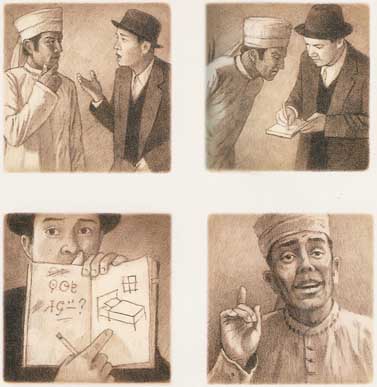
After recently watching a wonderful interpretation of Shaun Tan's Arrival, which can be watched by following the link, I gained a new perspective on teaching second language learners and educating children from various cultures and countries. Tan's novel, which is not completely shown in the YouTube video, follows a man as he throws himself to a completely foreign and new country. He experiences new customs, language, and interactions. These differences limit him from being able to have a job, except from a mindless factory job. Tan's thoughts pretty accurately reflect our view on immigrants in America. We seem to have this underlying idea that if English cannot be sufficiently spoken, a person's worth diminishes. When thinking about our students in our classrooms, do we hold these same biases? Should our English language learners be required to take assessments in English, or provided opportunities in their native language. It is a debate that is hot in education today. Tan continues his story, outlining the bitter struggles the man endures, but eventually he is able to earn enough money to send his family so that they join him in the new county.
The man's language abilities are not seen as worthy of holding a non-factory job, and the question of "what it means to be literate" can be pondered through this story. If we say that literacy is a means of communicating, then this man is literate in his own sign language and his native language, but not the countries main language. Is he literate? Are our second language learners literate if they cannot speak English, but achieve milestones in their first language? These types of questions need to be considered when thinking about teaching literacy in early education. Our own thoughts can be reflected in the manor in which we teach all types of learners. Thinking about establishing an inclusion setting, a community-based model in the classroom, and an anti-bias approach in my classroom, I can only come to the conclusion that requiring English language learners to solely communicate literacy in English is wrong. As teachers, we can think of creative and innovative ways to connect the first language to the classroom in a meaningful way.
Tuesday, November 15, 2011
Empowering Children to Think Critically and Tell Stories
One of the most powerful strengths a teacher can facilitate within her students is giving children a voice. In Negotiating Critical Literacies with Young Children, a teacher explains her experiences with a kindergarten classroom. She takes us through the process of setting children up for critical thinking, and exposure to intense literacy, and the opportunities to use their well-develop literacy skills. The chapter encourages teachers to answer children's questions with a challenge, instead of a blatant answer or another reframe of their own questions. These methods are usually, harmless, but they also do not grow children in their critical thinking and literacy skills. Instead, if we answer children's questions by pushing them to figure out the problem, challenge it, and create a change, we are setting the stage for a rich literacy experience and exponential growth. The example provided takes us through a kindergarten class's frustrations of being excluded from a school-wide cafe, which has been reserved for first-eighth grades. When a child asks the teacher why they are not allowed to go, she responded by asking "what can we do to change the situation?" This simple change in diction and attitude towards the capacity and willingness of children to make change happen creates an incomparable change in environment and exposure. The children are not required to work together, debate, reform ideas, and reshape opinions to come to a common end. The suggestions provided by Negotiating Critical Literacies with Young Children allow teachers to foster a meaningful, rich, and relevant environment, that does not limit able children to surface level topics, but digs deeper and enriches their literacy functions on the way.
Children's storytelling capacities can be imperative to their literacy development, and success as a reader. Teachers have the chance to create an environment that supports children as writers, provides the tools for storytelling, sets the stage for what a story includes and embodies, and celebrates children's final creations. In Castle in the Classroom, Georgia Heard explains how she facilitates writing in her own kindergarten classroom. Instead of simply reading children a story, providing them blank booklets and writing materials, and saying "go," Heard has an elaborate, carefully planned out list of activities and lessons that educate children about what stories can mean, what they can include, how they can be told, what they can say, and how they can say it.
This type of background includes lessons in:
- Stories Have Settings
- Stories Have Characters
- Stories Have a Sense of Time
- Stories Have Problems
- Stories Have Solutions to Problems
- Writing Descriptions of Settings
- Writing Character Descriptions and Dialogue
- Writing Golden Lines
- Exploring Story Planning
- Exploring Story Writing
- Writing Story Titles
Not until a teacher has successfully introduced and integrated these concepts together, does she expect children to be equipped to produce a full story. When a teacher brings children through the process of understanding storytelling through these interactive, fun-filled lesson plans, children get to the last three steps, and they are flourishing with ideas and plans for their own storybook. When the rough plans have been created, using many mediums for illustrations, teachers can formally publish the books for each child. This culmination project leaves students with a beautiful piece of their learning from many weeks of study, work, and determination. Castle in the Classroom provides teachers with explicit instruction to create storytelling mentalities within each of our students, and the manner in which to introduce concepts to empower children in storytelling.
Children's storytelling capacities can be imperative to their literacy development, and success as a reader. Teachers have the chance to create an environment that supports children as writers, provides the tools for storytelling, sets the stage for what a story includes and embodies, and celebrates children's final creations. In Castle in the Classroom, Georgia Heard explains how she facilitates writing in her own kindergarten classroom. Instead of simply reading children a story, providing them blank booklets and writing materials, and saying "go," Heard has an elaborate, carefully planned out list of activities and lessons that educate children about what stories can mean, what they can include, how they can be told, what they can say, and how they can say it.
This type of background includes lessons in:
- Stories Have Settings
- Stories Have Characters
- Stories Have a Sense of Time
- Stories Have Problems
- Stories Have Solutions to Problems
- Writing Descriptions of Settings
- Writing Character Descriptions and Dialogue
- Writing Golden Lines
- Exploring Story Planning
- Exploring Story Writing
- Writing Story Titles
Not until a teacher has successfully introduced and integrated these concepts together, does she expect children to be equipped to produce a full story. When a teacher brings children through the process of understanding storytelling through these interactive, fun-filled lesson plans, children get to the last three steps, and they are flourishing with ideas and plans for their own storybook. When the rough plans have been created, using many mediums for illustrations, teachers can formally publish the books for each child. This culmination project leaves students with a beautiful piece of their learning from many weeks of study, work, and determination. Castle in the Classroom provides teachers with explicit instruction to create storytelling mentalities within each of our students, and the manner in which to introduce concepts to empower children in storytelling.
Wednesday, November 9, 2011
NAEYCAC on Twitter
This past weekend, the National Association for the Education of Young Children held its annual conference in Orlando, Florida. As technology has taken over almost every facet of our lives, it has also breached the NAEYCAC. Although I did not attend, I was able to follow the progress and conference key points through tweets on Twitter. These are some of my favorite tweets, which included the easily followed hashtag #naeycac
Social and emotional confidence is more important than knowing the alphabet.@OoeyGooeyLady #naeycac
- I love this, and thought it was a great and bold point to make. Children are under so many pressures in preschool, and learning the alphabet should second to protecting children. Empowering children with social and emotional confidence is the best education we can provide a child. Through this, children can become strong people, who are equipped to learn new things easily. Although the alphabet is important, it will come. Children who are damaged and self-conscious by kindergarten will most likely carry these traits with them through life.
Babies catalog sounds. The research says the key window to develop#language is 8 -10 months of life! ~ Dr. JoAnn Deak #naeycAC
- Early Childhood Education advocacy!! We often believe that talking to a baby before he can "understandably" respond is only for our benefit. Children are receptive, and take in the experience provided to them most in the formative, early years. Talking to, reading, playing with, interacting with, and writing with our babies are all great ways to start the early foundation of literacy.
Childhood has gotten too neat and tidy. Embrace the dirt and celebrate the mess!#balmeras #naeycac
- I completely agree with this! Our preschools are required to be neat, clean, and spotless, but that doesn't mean that our activities have to be!! One model that I recently observed provided children with clothes to change into at school. This way, children can be messy and fully experience the sensory activities provided in a messy fashion. Teachers can wash these clothes, and throw them in the drier before leaving. The next day, the clothes will be ready to dirty again. We shouldn't fear messy. It is one of the best ways for children to become attached to an experience.
Social and emotional confidence is more important than knowing the alphabet.
- I love this, and thought it was a great and bold point to make. Children are under so many pressures in preschool, and learning the alphabet should second to protecting children. Empowering children with social and emotional confidence is the best education we can provide a child. Through this, children can become strong people, who are equipped to learn new things easily. Although the alphabet is important, it will come. Children who are damaged and self-conscious by kindergarten will most likely carry these traits with them through life.
Babies catalog sounds. The research says the key window to develop
- Early Childhood Education advocacy!! We often believe that talking to a baby before he can "understandably" respond is only for our benefit. Children are receptive, and take in the experience provided to them most in the formative, early years. Talking to, reading, playing with, interacting with, and writing with our babies are all great ways to start the early foundation of literacy.
Childhood has gotten too neat and tidy. Embrace the dirt and celebrate the mess!
- I completely agree with this! Our preschools are required to be neat, clean, and spotless, but that doesn't mean that our activities have to be!! One model that I recently observed provided children with clothes to change into at school. This way, children can be messy and fully experience the sensory activities provided in a messy fashion. Teachers can wash these clothes, and throw them in the drier before leaving. The next day, the clothes will be ready to dirty again. We shouldn't fear messy. It is one of the best ways for children to become attached to an experience.
Technology and Preschool?
There seems to be much debate over the necessity, usefulness, and practicality of integrated technologies into a preschool curriculum and setting. Traditionalist usually believe that children should experience literacy, science, geography, math, and other subjects through the physical (non-technological) mediums first, then learn to use the computer and other techy sources. There is a new philosophy emerging that looks at children's home lives, and the amount of learning and interaction that exists through technological services at home. These teachers believe that allowing children the opportunity to use technology devices in preschool settings only deepens the knowledge, understanding, and curriculum integration of an activity. Take for example, linear activities like drawing, reading, writing on paper, are usually concerned with the basic level of understanding. When children write stories on paper, we stress things like progression of the story in the correct beginning, middle, and end format, and if the pictures match the words. Using technologies, or non-linear) tools to teach children, we can create experiences that integrate reading and writing without strict structure or restraints. Technologies allow for a new type of literacy, one different from the traditional "reading and writing." A new form has came into existence: a blend between the two that can be experimented and carried out at the same time. Another great benefit of teaching through technologies at home is the idea of the "third space." Children are exposed to technology at home, they are using it, learning from it, communicating with it, and using it for entertainment. In order to educate a whole child, in the most effective manner, teachers need to bridge the gap between home in school. How can we do this without technology? In many cases we can't. Children are truly digital natives that learn and absorb knowledge through tech tools.
Ideas for technology usages in the preschool classroom: blogs, wikis, podcasts, videos, and other emergent ideas from the children (possibly programs they are already using at home)
Ideas for technology usages in the preschool classroom: blogs, wikis, podcasts, videos, and other emergent ideas from the children (possibly programs they are already using at home)
Wednesday, November 2, 2011
Pretend Play: So Much More than Acting
Pretend Play can be under appreciated in preschool classrooms. Often, it is used as a choice area that children are welcome to visit along with blocks, art, reading, or other centers. Teachers often incorporate this area with kitchen and it together becomes "housekeeping" or "dress up." I have recently read an article that challenged teachers and parents to think about Pretend Play differently. Pretend Play uses children's imaginations, voices, and ideas to produce a social interaction between children. This time of situation can be used for so much more than modeling home-like functions. Teachers are urged to use Pretend Play as a tool in many portions of the curriculum. A great example can be seen through literacy. If a class is beginning a unit on fairy tales, I would urge the teacher to have the children create a script for the class to remake a common fairy tale (or a variant if they wish!) Then, the children can plan out how to reenact this particular story. Literacy concepts can be used through the script making processes, and children can imitate this in other subjects as well. The reason that Pretend Play is encouraged so heavily is because it provides a depth of experience that cannot be substituted with any other experiences. The act of interacting out loud to display a wealth of new knowledge with peers is unmatched. Children are gaining confidence, utilizing creativity, making deep, personal connections with the curriculum, practicing social skills, and creating unity through their school experience. Subjects should not be exclusive, but inclusive and each should be integrated throughout the entire curriculum. Creating this time of cohesive experience in a preschool setting will allow students to make connections between subjects, and allow them to think creatively and logically when problem solving. I love the idea behind Pretend Play in all areas of the classroom. Bring this experience out of the choice area, and into your daily activities. Let children enjoy the opportunities that Pretend Play provides, and watch as your students become critical, well-rounded thinkers through the curriculum integration.
Subscribe to:
Posts (Atom)